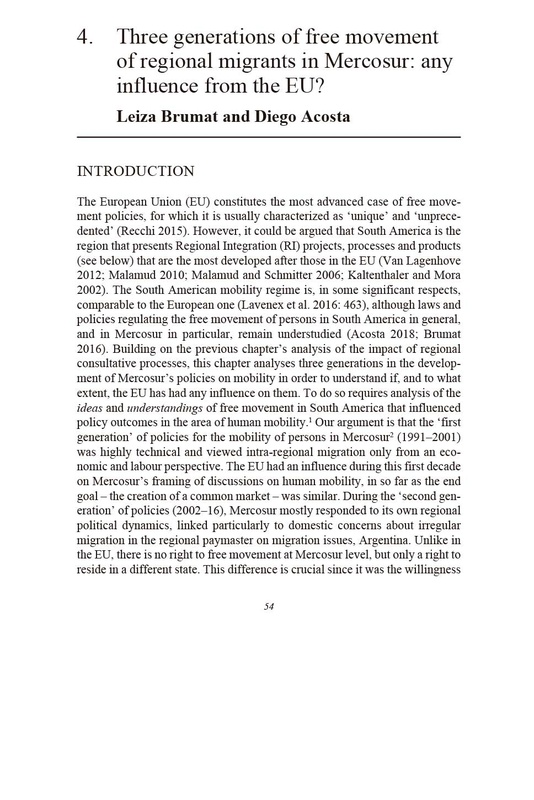
The European Union (EU) constitutes the most advanced case of free movement policies, for which it is usually characterized as 'unique' and 'unprecedented' (Recchi 2015). However, it could be argued that South America is the region that presents Regional Integration (RI) projects, processes and products (see below) that are the most developed after those in the EU (Van Lagenhove 2012; Malamud 2010; Malamud and Schmitter 2006; Kaltenthaler and Mora 2002). The South American mobility regime is, in some significant respects, comparable to the European one (Lavenex et al. 2016: 463), although laws and policies regulating the free movement of persons in South America in general, and in Mercosur in particular, remain understudied (Acosta 2018; Brumat 2016).
Suggested citation: Leiza Brumat and Diego Acosta, 'Three Generations of Free Movement of Regional Migrants in Mercosur: any Influence from the EU?, in A. Geddes, M. Vera Espinoza, L. Hadj Abdou and L. Brumat (eds.), The Dynamics of Regional Migration Governance (Edward Elgar, Cheltenham, 2019), pp. 54-72.